The meeting aired on Zoom and on Xfinity Channel 18. It was also open to the public at the Sheraton. The district typically posts the recording split into segments the day after the meeting or Xfinity Channel 18 will often replay it.
Note: Our family schedule this fall does not make live blogging the meetings easy this year. This year’s meetings have been more routine than 2021-2022. So, I will be recording the meetings on Channel 18 and blogging them as my schedule allows on Wednesday evening and Thursday morning. This week my daughter had a sporting event in Jackson and we did not get home until 9:30p – which is when I finally had dinner. I am watching and taking notes on Thursday morning.
Call to Order
Roll Call
Note: The Channel 18 recording started after roll call. Attendance is based on my observations
Present: Johnson, Kelly, DuPree, Querijero, Lazarus, Baskett, Gaynor
Other Attendees: Swift, Osiniski, Cluley, Linden, Parks, Heyworth, Maylone, Minnick, Bacolor
Agenda
The Agenda is available on Board Docs. This is the approved agenda and will include any updates and results of any votes.
Motioned by Querijero, Seconded by DuPree. Unanimously approved without discussion.

Public Commentary
As is our practice, we do not cover public commentary. There were 22 comments tonight each person got 2 minutes and 10 seconds – most of which are on Board Docs.
Clarifications
Swift: We appreciate everyone who has come out to speak this evening and by submitting comments. Many will be addressed in superintendent’s update. I want to clarify the first commenter that our sub rates are at $130/day as amended last year and $200/day for building subs and those committing on an on going basis at $180. I’ll be sharing more in our update
Reports of Associations
None tonight
Board Committee Reports
None tonight
Information
Superintendent Update
District wide culturally responsive teaching session occurred last Wednesday with about 2000 team members present in virtual.
Very grateful to hear from Dr Kellstrom that AAPS as of yesterday has been awarded an e-rate emergency connectivity fund award of $2.2 million. We applied quite awhile and thought it would by $90K. This will help cover associated fees with 6000 chromebooks.
Ms Margolis also got word on FEMA grant to reimburse for PPE and supplies. We were originally denied but they updated award criteria. We got $40k of $47k we applied for. This helps redirect general fund monies to other purposes.
Transportation update: I have shared in weekly updates with exact numbers of drivers we have, hired, in training, etc. Most of 100 routes are being served each morning and running on time. There are probably about 90 drivers on full time. We are about 10 short. We have 5 available from leadership team and 15 in training. We expect to bring them on in coming weeks. The cushion for substitute drivers is still thin and where we have our challenge. Mornings when an employee calls in – whether they are ill or have a sick child at home (twice this week was a sick child). We are far better than we were at the beginning of the year with aggressive recruiting and realigning of hourly wages. We only have 2 routes now that remain combined that causes students to be a bit late. We want to improve and repair that situation.
Other areas of staffing progress, we have aligned hourly pay, salary, and benefits across positions across AAPS system to ensure they are competitive across Ann Arbor and Southeast Michigan. We are seeing results from that work to align salary/benefits, aggressive recruit. and virtual job fairs.
We have filled all special ed teachers except 2 at high school. Significant progress. We are still short paraprofessionals and we will continue that recruitment.
In preparing for more staff absences, we knew with COVID and seasonal illnesses we raised sub rates to the highest in the county. One other raised theirs to match hours. We provided 5 full time to every elementary and 6 to every secondary school. Those are available and help out every day and have been needed. In addition, members of our team routinely give up planning periods and we redeploy staff across district when we run short.
Our substitute/guest teacher team is larger than it has ever been. As of Monday, we have 687 active teacher subs who have been through the application process. They may not be available every day, so we have a strong sub pool and are aggressively looking to add to the pool. Our update last week we shared information on how to join.
Despite that there are days when the number of open positions is significantly higher than subs available. That is the nature. I’ve shared that concern in updates and with parents and the community. We all will need a backup plan. I don’t make decisions lightly, they weigh heavily on us. The stress of closing a school for inadequate staff, the concern is far greater that if as a result of a short staff situation a student or staff member would be placed at greater risk. I say that very seriously. This is what we have to think about.
We will continue about job fairs and be realigning the Friday/Monday sub-pay. Before the pandemic there was a bit more pay those days. When we upped the rates last summer, we failed to keep that bonus. We will be putting that extra back as those are showing to be the most concerned days. Then Ms Osinski & Mr Cluley have some data slides to put up to show the community where we stand..
Yesterday great progress with pediatric vaccines. I know we’re all delighted to hear we are moving closer in our efforts to ensure our children are vaccinated. Members of our team are working with MDHHS and we will be prepared to support vaccination efforts in our schools.
Our school teams and students are following COVID mitigation steps. I appreciate school teams doing contact tracing alongside county health department. Our team is out doing COVID testing in various locations every week in response to situations at schools. We continue to see high level of COVID transmission we unfortunately have seen some evidence of school transmission. But we are now in a second week of a decline in AAPS. Last week we were at less than half of the prior week. To date this week we are at a decrease. That will have a positive impact on keeping children and staff ins chool.
As we move into winter months with other illnesses, it is important that students and staff stay home with symptoms. Vaccinated staff and students are less impacted, but we did have 6 breakthrough cases last week among staff. We continue to encourage those eligible to get the booster. It is an important step for our staff to take.
We do take decisions to temporarily transition to virtual learning seriously and prioritize in school learning. But when staff illnesses and absence exceed levels of substitutes last Friday and in one school on Monday, we will temporarily move to a virtual setting to ensure situations are safe.
Last Friday, we had more absences than in any prior day. There were 503 absences and a 54.5% fill rate. That was far beyond the ability to cover the positions. the 503 is across all positions not just teachers. If you look at Monday, 422 absences but the issue was with one particular school. If those absences are concentrated in one team or a special needs support group, that group will dramatically impact health and safety of students and we will have to make a decision.
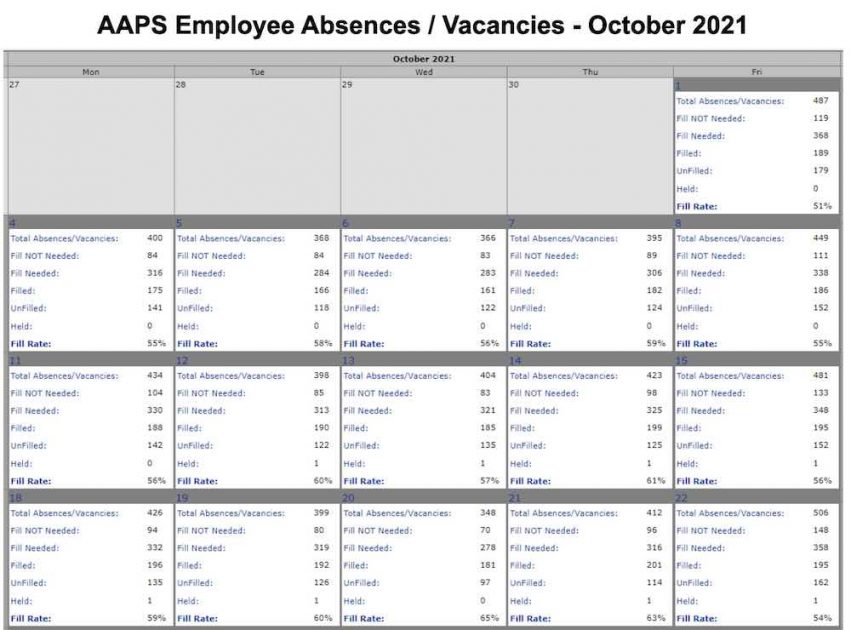
Yesterday (Tuesday), back down to 372 with a 69.6% fill rate. If you say how are you filling the other 30% – that is our staff. Using planning period, we are all deploying into buildings to support as much as we can.
We believe we can pull through with pediatric vaccines, realigning pays.
This is a time when every family needs a backup plan. I’ve said that before and we know we don’t have the cushion when our staff are impacted. The team is working incredibly hard. We do believe things will improve. You will see my team reporting remotely today. We meet daily at 9p and 6a to review the data.
We will add Thursday data and share out with the community.
Trustee Questions on Superintendent Update
Gaynor: I appreciate data to see absences and unfilled spots. I’ve been hearing anecdotally that teachers are filling in and overworked. This really puts it into perspective. I wish I had a solution.
Kelly: OF the 506 absences, what is the total staff number.
Swift: I have to reach otu, but I believe yesterday’s number was 2382. So about 25% overall.
Kelly: Do we understand what the trend is?
Swift: It is what you would expect – personal illness – not always covid, illness of children or family, it is life. Teachers go on leave (maternity, surgery). Those are the main trend, but a few are positions that are not yet filled and on-going vacancies but that isn’t themajority.
Querijero: Of the 500 can you give a trend of teachers vs administrators or unfilled positions. How many of the actual teaches are filled.
Swift: I’ll always try, on Friday it was 112 unfilled classroom teacher positions. The other part is harder4 to get to because counselor or social workers wouldn’t necessarily need to be filled.
Querijero: The 500 doesn’t represent all absences in the district?
Swift: It does, but you’ll see the no fill needed number. I want to check on this, because I don’t use this daily and want to be suer I’m saying it properly. The yellow square are the ones that need fill that are left unfilled.
Querijero: What do we do when we have a spot unfilled? So the community understands the challenge.
Swift: Today at Skyline there are 6 uncovered. That means the principal is working 5-7a to see who can fill what hours. We deploy members of our team to teach whenever we can.
Lazarus: I’d like to say this is the reality. These are teachers, staff who have accumulated the right like any other employee to take time off. Some are sick, family obligations, etc. When you look at it in the reality of today with more sickness than normal, where is teh comparison to pre-COVID? Aer we running 25% on Fridays and Mondays pre-COVID?
Swift: We’ll put it together. We are seeing about 30% more. A 300 absence day would have been a 200 absence day. We have to go back to 2019 to compare.
Lazarus: I want to say thank you for being one of those subs. I’m sure Tappan enjoyed that. I look forward to that report.
Fall 2021 Equity Update
Swift: We have a few folks joining remotely.
Note: Two documents are available on BoardDocs: Framework for Equitable Instruction 2.0 and Culturally Responsive Learning, Teaching & Leading Plan
They were joined virtually by Ms Linden (Assistant Superintendent for Teaching and Learning), Ms Parks (Assistant Superintendent for School Leadership), & Dr Heyward (Executive Director K-8 & Middle School Education)
Swift: We were last together in May for a spring update.
Our focus this year is building individual, team, and organizational capacity and developing a foundation of shared language and understanding around equity work. This spring we shared it’s about 3 areas
- Transforming Culture in organization
- Shifting daily practice in classrooms, schools, and community
- Redesigning the system to engage, affirm, and celebrate students for who they are and what they bring.
The work this year is engaging and learning together on the teacher pathway, leadership pathway, student pathway, etc. We’ll show work with student voice and are excited to engage with parents and community members.
Ms Linden will share culturally responsive framework in how we ensure an equitable framework for instruction.
Linden: “Equity is Everything.” Equity translates to care. I’ll share where we’ve been and where we’re going. You’ll see a bit of context.
She shared highlights from the AAPS Framework for Equitable Instruction. We haven’t seen what we want yet. Our goal is to create spaces where students are centered, supported, and challenged. They can access learning and can be their authentic and true self. We want spaces like that for each and every student especially those in groups previously underserved. When we are successful, there will be no predictability to success based on these groups. We’ll be monitoring.
In 2020, our pandemic year we made some shifts. We made sure learning was accessible to all. You heard about two big areas of focus universal design and SIOP (Sheltered Instruction Protocol). SIOP is especially useful for English Language Learners. It makes sure students can come to learning regardless of background information, vocabulary, etc. They were driving where we were last year and making sure online learning experience was accessible and predictable. We standardized across district. We listened to teachers and what they learned in the COVID year.
There was a voluntary professional development pathway. Students feeling culturally disconnected was a big issue. We brought in 2 renowned speakers for 6 90 minute sessions. In many cases it was outside of the school day and over 400 team members participated. What they learned was they wanted more and to engage with colleagues.
In 2021 and beyond we are making this the work and learning of every member of the team. It’s an exciting part of our journey to be more culturally responsive, equitable, and engaging.
There are 4 design elements on design side we want all our teachers to be aware of in mindset and pracitce
- SIOP
- Universal Design
- Cultural Affirming
- Active and Engaged Instruction both in person and to engage outside the school day at their own pace
Now a framework to help guide teachers in developing lessons. You’ll notice this is 2.0. It is our second year of revision of the document. It is a process and it will evolve as we get better.
Parks: We began professional development pathway in spring 2021. The goal this year is to expand and deepen learning to grow our mindset and practice. Every member of the school team is engaging in culturally responsive teaching series. Dr Sealey-Ruiz will be with us about 6 times this year to develop self-awareness as educators. She lifts up understanding of self-reflection and humility are crucial both individually and as a group. Embracing culturally responsive mindset as individuals and a system is a pathway to focus on to honor all families.
Also, our leadership council – more than 100 leaders through the system – through engaging to open eyes to the genius every student possesses. It is incumbent on us to make sure our students are celebrated and not tolerated.
Dr Heyward will talk about the student pathway.
Heyward: Culturally responsive learning alongside students is a critical component to leverage student voice and experience. We want them to feel valued and part of the decision making process. Student equity teams, student affinity groups, peer to peer, etc. which are open to any student. Advisory lessons with themes. Student groups engaging with building leaders and at a national level.
Goal is to have student equity groups in every school.
Swift: In addition to pathways for all staff is the student and teacher pathways. We’re confirming dates with Dr Sealey-Ruiz to share with the community. It’s important to have the shared understanding and language. Looking at November 2021, February 2022, and April 2022.
Plus also adding affinity groups like students of color, staff of color, LGBTQ+ groups for staff and students. To get to the students and get feedback on their experiences. We’re going to bring a big formal plan. I appreciate comments of AASPIRE tonight and agree with every item they want to see in the plan. Our focus first is on the 2021-2022 phase.
Areas of study are racial literacy including bias training, archaeology of self, and equitable leadership practices. We’er excited to engage with our own team members and students/student groups, to engage with parents and community groups. Yesterday I had an invite fro the Arab American support group. From there we are looking at a district equity advisory group representative of all those voices.
We want to spend the next weeks and months engaged in the community conversation and ensure all voices are heard and talk about how we will measure success in equity. We’d like to come back in spring with what we’ve heard from community and staff for how to move forward in 2022-2023 and beyond.
Trustee Questions on Equity
Gaynor: Ms Linden thank you for presentation on the framework for equitable instruction. I appreciate you go back to teachers for feedback. This is a remark partly as a trustee, partly as a teacher. The universal design and SIOP I think teachers have learned a lot from that and making sure everyone is included and getting the instruction they need.
One thing that stood out to me and it may be slides not intention. One of the pillar was active and engaged learning. It talked about blended learning. There’s a difference between incorporating technology and the one to one attachment of students to learning applications. I am concerned that sitting kids one on one in front of a computer does not provide for the connections and relevancy. I’d like clarification that this is just one small part of how we use technology to be an engaged and active learner.
Linden: If you look at guiding questions, you’ll see it is about giving students access. For example, if I need a little more outside the school day to grasp a concept. Do I wait the next day to ask the teacher? That’s one part of it. When we use blended learning we mean technology in service to learners. Students can move at their own pace. Extend or go back to fill a gap as needed. We talk about Schoology as our ecosystem. The intent is to have a place safe for students to own their learning. They can see their progress. Teachers can provide feedback as they grade and students can get immediately. Students can do revisions. It isn’t a goal to sit at a screen and move through a program. We’ll monitor. There is no replacement for dedicated teachers.
DuPree: I was curious about Dr Heyward spoke about student equity and affinity groups. How do you recruit students to join? And make folks see it isn’t divisive but a tool to build a community.
Heyward: Schools promote student groups in various ways – slide presentations during advisory, morning announcements. It’s building a culture in the building that students can participate in any affinity groups. Its engagement with teachers, peers, building administrators.
Querijero: More comment than question. Thanks for the work in this area. In a bigger picture what I like about what I see is we start with equitability among students. As I look at the boxes and being a teacher myself, it’s easy to think about them outside instruction and in the district as well. Can the experts broaden the scope of those values across the district and not focus all on students and apply to adults as we interact with each other professionally. We’re the ones doing the work across the board.
I think it’s smart to start with students, but anything we can take from that it makes sense to broaden it outward.
Gaynor: I agree with the importance of centering students. President Johnson you were one of 3 that met with representatives of AASPIRE.
Kelly: Trustee Gaynor I hope you don’t mind me jumping in. I think I can report out in conjunctions with some of my questions. A commenter reported concerns in 4 points. -knowing problem, making sure goals are measurable and attainable, time limit, understanding accountability, what is the evidence the plan is responsive to all learners. The meeting was 90 minutes and so much more than can be distilled in those 4 points.
This is a commitment to start. I don’t want that to mask the deep work that has gone into it. A very high level of theoretical and academic work to identify best practices. My question is when will it be tangible that we can put our hands around and talk about.
Linden: You should see tangible evidence of the instructional practices happening in our classrooms now. Declaring that this is our commitment doesn’t mean we have arrived. It means we have heightened awareness and are working hard. We’re going to notice things and react and have urgency around it.
We’ve got to ask students. Dr Heyward mentioned all the ways we check in with students and hear from them.
Kelly: What I love about that response, it isn’t setting it up as a school with equity tacked on. I hear you describing it is to make education work for kids. I love checking in with students and hearing their experience I wonder how we measure the baseline to then see it is changed. Will the generation of students say who are in K today be different than today’s HS students.
Linden: It’s a great question. We have the climate survey we do each year. That’s one tool. But there’s no replacing conversation in classroom, but that’s hard to make tangible. Int he last few years we engineered questions to get data on how students feel in our classrooms and experiences. We know students the more agency and valued they feel, the more they want to be there. We should see engagement go up, attendance go up, negative behavior go down, grades/performance go up.
Parks: Our student pathway is a crucial component so we can capture that student data to inform our practices. A measure will be when students can step forward with their authentic experience and know it will be acted on.
Kelly: About the advisory group, what will. be the charge of the advisory group. What is the timeline for composing it? Who and how will the participation be.
Swift: Those are great questions that we are discussing with trustees and members of the committee. I’ve seen it across the country and having representatives from each of our established parent groups. They’re excited since they haven’t had much chance to interact across the parent groups.
Kelly: I notice professional development is voluntary at this point. I feel the people who most need it aren’t volunteering
Swift: Correction, last spring they were voluntary. This year they are everyone. What I love about the COVID year last year and volunteer attendees, they started a movement. It was more powerful than the normal everyone come method.
DuPree; When we had the trainer here and reviewing roles and responsibilities of the board, there was a brief discussion about microagressions. Is there a path for that being planned? As leaders in the district, I think it’s important we hold the same standards.
Swift: The experts are interested in helping the board. If you want to go to the general sessions and then talk about as a board what you want to do. I’ve sent you copies of their books and how you see their
Baskett: First, let me acknowledge the AASPIRE group and trustees for meeting with them. I appreciate that we are going out in the community. This afternoon I attended the Color of Education Symposium (2 day workshop of North Carolina educators). I’m looking for the role in professional development of us as trustees. They had one for administrators, direct educators. I went to one for community engagement. One of the things a panelist said, is lets not forget the generational people at the table. We have people who have done this before. For new people, you’ve missed the beginning of the movie. As Ms Linden said this is a work in progress. To me the framework is a framework of work. We can’t stop to perfect a plan for the educators to continue the work. Having done community work, it’s easier to go out with something to build upon rather than the great minds trying to build it from scratch.
I don’t think we know enough of the history. Some of us were students of AAPS. The measure is the difference between then and now. President Johnson, we have similar experiences but are a few years apart. Students today have some similar stories. I don’t want to dismiss the fact that the needs pointed out by AASPIRE we have acknowledged already. I’m still struggling as a board member with what we need to do as a board. One of our past consultants brought forth policies for us to look at. I’d also be interested from a legal perspective. What issues have other boards faced.
Make sure we are building bridges and not walls. For whatever reason people today are assuming the worst of us. Educators voluntarily gave up their time. I don’t get the negativity, but I do understand. the impatience of it. I think if there is a weak link, I’m not seeing what we need to do.
Kelly: I appreciate that question and would point to the mailing I got for the MASB annual leadership conference. There are in person and virtual sessions that address this issue. Perhaps start there.
Baskett: There is a DEI presentation on Thursday I mentioned before. I just got the booklet today and didn’t read all the sessions yet.
DuPree: Did you have any conversation on engaging new voices? I did not go to AAPS but DPS.
Baskett: The panelists talked about the voices we need and some of those could be new voices. That could be something we shoot for as a board.
We used to be a more active member of Minority Student Achievement Network which used to have a board component. That’s faded over the year and they used to have a board component, but I don’t see that much.
Also about MASB, their staff isn’t very diversified. How much credibility do they have around DEI.
DuPree: We’re asking parents and students and staff to have very raw conversations, but as board members we aren’t having that conversation.
Baskett: We haven’t done a lot of professional development in public before and we got a lot of push back. It’s almost like doing marriage counseling with your in-laws in the room. We need to get to the level of understanding of what is the role of the board.
Johnson: In the interest of time, I have a few questions. Going first I have some of them answered already.
Querijero: One more comment first, Trustee Kelly brought up assessment and how we would do that. My thought is it is a difficult thing to assess. I’m not sure we’re ready to assess equity when we haven’t come together to talk about it before. My guess is when we heard experts, some teachers said I do that already and others say am I supposed to be doing that. I think we have to do more on the conversations first and what we mean about equity that we are talking about the same thing. I see assessment as a year 2 after we’ve done our listening and engagement with the community. It’s too early to talk about progress when we don’t know yet who our partners are.
Johnson: That’s a good point. In our meeting with AASPIRe one topic was frustration with the speed we were moving. If you look at our current draft plan completed for board approval in 2019 then we got sidetracked with the bond process and then COVID in 2020. The pillars were centered around how we talk about equity – building leadership capacity, educating them, and developing through there. Each of those pillars had a measurement component. Student performance data, attendance, engagement, discipline, climate survey, etc. What was missing was the specifics of how we would do that because it was early.
The groups concern is we should have that now. But we feel there is work to be done. The community isn’t ready. But as Baskett said you can’t wait for a perfect plan to start doing some of the work. It isn’t perfect but it is a serious effort. I appreciate everyone who shared it tonight. We’re familiar with our history. In that meeting I was being educated about district history that I actually experienced as a student. This is a generations long challenge. Hopefully it won’t take generations to eliminate the predictability that Ms Linden spoke about.
AAPS Services and Supports for Homeless Students
Swift: We have Alicia Maylone the McKinney-Vento and Foster Care Liaison and Ms Linden who oversees this portion of our work. Our approximately 300 homeless students are in buildings across the district.
Maylone: McKinney-Vento is a federal law that ensures educational access for students who lack fixed, regular, or adequate housing. Displaced families can have difficulties reaching school via transportation issues and educational documents.
The research shows importance of maintaining enrollment in home school. Each transfer can cause loss of 4-6 months of learning. On time graduation are 40-60% for students with homelessness or foster care across Michigan and AAPS is similar.
Schools should expect 10% of free/reduced lunch to be McKinney-Vento students. A larger number is usually good and associated with increased identification. AAPS is typically in the 7-9% of free or reduced lunch so we likely have unidentified students. With lower numbers during the pandemic, it is likely due to lack of engagement with virtual learning.
Support includes enrollment support, educational planning, Title I services, transportation, financial assistance, health resources, and more. They also provide outreach with other community service providers.
The pandemic has impacted McKinney-Vento support by making identification difficult, greater needs with childcare and nutrition needs, reduced access to systems. We probably won’t be able to measure the full impact for some time.
School team members receive training and support for how to identify students who need support. Information is on posters in schools, community locations, and district website. Every school has a designated point of contact – available here.
Next steps include increasing training especially around identification, monitor those with greatest needs, and engage with local partners.
Trustee Questions on McKinney-Vento
DuPree: Thank you for report. It was very thorough and highlighted something very important for how students feeling welcome can affect their education. Part of the law says training must be received by liasons. How is that done?
Maylone: Any opportunity we have for training is important. That usually includes small groups with social workers and other staff. This year in particular we’ve been working with administrative teams.
Baskett: I want to recognize your work by telling this story. I attended a state of the schools presentation and was touched by a student who stood up. and talked of your work with her over the year. The story of not being sure she could go to the prom and how you helped make that happen. You also helped her get a scholarship to college and make the physical move, but the prom was a special moment. My question is can you approximate the lenght of time you could work with any one student?
Maylone: If I’m not mistaken that was a collaboration among the Skyline team. For timelines it varies. Some may meet the criteria for multiple years, or sometimes they stabilize temporarily and then return again. We always like to know about developing situations and be able to help before it reaches critical levels. Typically it impacts families and can reach across multiple buildings.
Kelly: In the special education world, children hit transitional services around 16 to help them navigate the future world. Do we use something similar for your families?
Maylone: We do start preparing for the next school year, transitions to a new school. Our seniors have different supports built into the law and do include FAFSA and transitional housing.
Kelly: How do you communicate it is confidential and can help families who are concerned about getting help because of immigration status, situation they are trying to escape?
Maylone: Confidentiality is second only to safety and protection. We enter data in systems but set alerts on who accesses it. inform them how and where data may be used. Our schools have limited personnel with access to the information beyond a status indicator.
Kelly: What do you need from the board? What barriers do you need removed?
Maylone: In our current context when focusing on ensuring operations continue as smoothly as possible.
DuPree: One of the things is I notice the need to provide public notice that services are available. How do you address barriers in language and educational background when communicating with families.
Maylone: We meet families and students where they are. That includes access via language and comprehension. There is clear information in our enrollment depending on how they are enrolling. The formal referral process does include multiple language4s. We rely on our EL staff and interpretation services.
Swift: Ms Maylone I want to publicly thank you for the work you do. In the grocery store, the hotels, getting a family moved due to allergies, and so much more.
Monthly Budget Monitoring Report for September
Swift: The budget has been on a roller coaster since March 2020 with going remote, ESSR funds, hybrid learning, and more. Next meeting is our annual budget audit.
Note: The budget presentation can be found on BoardDocs.
Minnick: This year we have several new sources of funding and some new expenses. We are expecting differences some good, some bad. There are also additional costs as operating costs have gone up – food, fuel, staff, etc. As we return to in person learning, we will see changes in our community services fund and student and school activity funds.
In Cash and investment funds, in summer 2020 we received a big chunk of state aid and in the last year we have spent it down since then. We are close to our September 2019 cash and investment holdings.
Expenditures difference in General Fund are mostly increased cost of goods, although some due to timing of purchases. Large percentages in income and spending on student & school activity fund, but dollar values are relatively small.
Swift: Those are student funds for clubs and activities that didn’t really happen last year. This represents that we are back in action.
Johnson(?): Can we see the comparison to 2019
Swift: Yes, we’re figuring out how to include that. But it is more in line. with 2019 and 2020 is the outlier.
Minnick: On Comparison of All Funds report. The Beginning fund balance is the same for 2020-2021 and 2021-2022. That is because. the audit is not yet complete.t will be updated with the new data next month after the audit is complete.
So far we have not received any state aid which arrives in October or federal funds to request reimbursement. We have only collected property tax so far.
Trustee Questions on Budget Monitoring
Gaynor: You definitely answered my questions and that last year’s numbers were an anomaly. Your explanation makes sense.
Lazarus: I would add on that because we don’t get a state aid payment in September it is consistently in the negative.
Swift: It is one of the reasons fund equity is so important. We have to be able to make payroll in those months.
First Briefings
No First Briefings
Second Briefings
Second Briefings are provided on
- Annex AN-2061 Pediatric Therapy Associates Agreement
- Approve Annex AN-2063 Road Salt Purchase
There were no updates on these items and no trustee questions.
Consent Agenda
Four items on the list
- Approve Annex AN-2061 Pediatric Therapy Associates Agreement
- Approve Annex AN-2063 Road Salt Purchase
- Approve minutes from October 13 Regular Meeting
- Donations – air filters and purifiers to various schools.
Kelly: I have a question about the air filters. I appreciate our community donating air filters. But I wonder about the sound quality in the classroom.
Swift: I’d appreciate teachers weighing in, but when I’ve been in classrooms teachers are wearing their mikes and it hasn’t been an issue. They do open windows first when that is possible. I want to appreciate the community working within the guidelines we setup with Mr Rice and Lauzzana to buy quieter models.
Motioned by DuPree. Seconded by Lazarus. Motion passes unanimously
Board Action
Approval of Recreation Advisory Commission (RAC) Recommendation for Membership
Swift: We have Ms Bacolor popping on. You already have her recommendation. This is “normal” work.
Bacolor: Recration Advisory Commission was established decades ago. There are 12 voting members, 6 appointed by the Board and 6 by Ann Arbor City Council. Thank you to President Johnson as the board liaison to the commission
They reviewed candidates to help the commission better represent our community – age, school community, geographic, racial and ethnic diversity, and more.
They have 4 candidates:
- Stacy Ebron – Lawton parent & PTO Co-President
- Hadil Ghoneim – Burns Park parent & Arab American Parent Advisory Committee
- Hannah Smith – Community Member on northside of town. Former Rec & Ed youth sport coach, participated in adult recreation classes
- Zachary Weiner – 11th grade student at Pioneer HS and a HS volunteer in summer camps program.
Motion to approve Stacy Ebron, Hadil Ghoneim, Hannah Smith, and Zachary Weiner for 3 year terms by Gaynor. Seconded by Kelly. Unanimously passed.
Motion to Approve a Closed Session on November 18
The Closed session on November 18 at 7p is for attorney/client privilege.
Motioned by Querijero. Seconded by DuPree. No discussion. Unanimously passed.
Items for Agenda Planning
DuPree: I want to ask for conversation about the TRAILS program since it was brought up in public commentary.
Johnson: We have heard that and have it on the docket to get in.
Items from the Board
Gaynor: You sent me an email last week following public censure you are removing me from several committees. Was that email sufficient notice or should it be done publicly at tonight’s nmeeting.
Johnson: That email was sufficient notice according to our bylaws and it was released to the public. But, I was going to mention it so thank you.
Johnson: I was going to mention that this weekend I had the pleasure of attending the opening of the African American Cultural Historical Museum on Pontiac Trail. Definitely a testament to folks in this community and to preserve the history of African American in Washtenaw County and Ann Arbor specifically. They’re engaging in a fundraising drive to expand the museum. I’d love to see a way for our students to leverage what is being displayed there with history classes and field trips.
Adjourn
Moved by Kelly, seconded by Lazarus. Passed unanimously at 10:23p.